
links for 2009-03-01
-
"Who do you talk to most often on Twitter? Who are your closest friends? What does your social network look like?"
-
"Humor helps preserve our sanity. It provides a medium for gentle reprimand. And it teaches us to take ourselves less seriously. But we must never forget that good humor never diminishes the reality of suffering."
[...]
"In this world, tragedy temporarily has the upper hand. We cannot pretend that humor can solve our tragic position, but we can learn to laugh even within the pain, if we follow Christ’s example. Christ was joyful, not because He had nothing over which to sorrow, but rather because He knew that He would one day conquer the powers of darkness and make all things right."
Charles Platt, long-time journalist and former senior writer at Wired, went undercover as a Walmart employee, and discovered the company is not as bad as it's been made out to be:
I found myself reaching an inescapable conclusion. Low wages are not a Wal-Mart problem. They are an industry-wide problem, afflicting all unskilled entry-level jobs, and the reason should be obvious.
In our free-enterprise system, employees are valued largely in terms of what they can do. This is why teenagers fresh out of high school often go to vocational training institutes to become auto mechanics or electricians. They understand a basic principle that seems to elude social commentators, politicians and union organizers. If you want better pay, you need to learn skills that are in demand.
The blunt tools of legislation or union power can force a corporation to pay higher wages, but if employees don't create an equal amount of additional value, there's no net gain. All other factors remaining equal, the store will have to charge higher prices for its merchandise, and its competitive position will suffer.
This is Economics 101, but no one wants to believe it, because it tells us that a legislative or unionized quick-fix is not going to work in the long term. If you want people to be wealthier, they have to create additional wealth.
To my mind, the real scandal is not that a large corporation doesn't pay people more. The scandal is that so many people have so little economic value. Despite (or because of) a free public school system, millions of teenagers enter the work force without marketable skills. So why would anyone expect them to be well paid?
[...]
You have to wonder, then, why the store has such a terrible reputation, and I have to tell you that so far as I can determine, trade unions have done most of the mudslinging. Web sites that serve as a source for negative stories are often affiliated with unions. Walmartwatch.com, for instance, is partnered with the Service Employees International Union; Wakeupwalmart.com is entirely owned by United Food and Commercial Workers International Union. For years, now, they've campaigned against Wal-Mart, for reasons that may have more to do with money than compassion for the working poor. If more than one million Wal-Mart employees in the United States could be induced to join a union, by my calculation they'd be compelled to pay more than half-billion dollars each year in dues.
Anti-growth activists are the other primary source of anti-Wal-Mart sentiment. In the town where I worked, I was told that activists even opposed a new Barnes & Noble because it was "too big." If they're offended by a large bookstore, you can imagine how they feel about a discount retailer.
The argument, of course, is that smaller enterprises cannot compete. My outlook on this is hardcore: I think that many of the "mom-and-pop" stores so beloved by activists don't deserve to remain in business.
When I first ventured from New York City to the American heartland, I did my best to patronize quaint little places on Main Street and quickly discovered the penalties for doing so. At a small appliance store, I wasn't allowed to buy a microwave oven on display. I had to place an order and wait a couple of weeks for delivery. At a stationery store where I tried to buy a file cabinet, I found the same problem. Think back, if you are old enough to do so, and you may recall that this is how small-town retailing used to function in the 1960s.
Strange, isn't it?
SUPPORTERS OF ABORTION RIGHTS bristle at the term "partial-birth abortion," and sympathetic journalists often make a point of setting it off with scare quotes or injecting a phrase meant to dilute the term's grisly legitimacy -- for example, "a controversial procedure that critics call 'partial-birth abortion'" (as the Los Angeles Times has put it), or "a ban on so-called 'partial-birth' abortion" (to quote Reuters).
But what happens to such fastidiousness when it comes to terms coined by liberals? Terms like "Fairness Doctrine" -- an Orwellian label for government stifling of untrammeled political speech over the airwaves. Or like "Employee Free Choice Act," a benign title for legislation that would deny employees the right to a secret ballot in workplace elections. Strange, isn't it, how the concern with terminological exactitude kicks in at the appearance of a freighted expression from the right, yet fades into the mist when the language comes from the left?
links for 2009-02-28
-
"This script provides a fast way of adding new tasks to a Taskpaper document without leaving the current context and switching to the Taskpaper application.
"It works for both Quicksilver and Launchbar." -
A bit of common sense (all writers are different and write in different ways), with some insight into how Miller views the post-writing publishing process.
-
Really for those willing to spend big bucks for more in-demand domains.
Brothers at War
This looks good.
"Brothers at War is an intimate portrait of an American family during a turbulent time. Jake Rademacher sets out to understand the experience, sacrifice, and motivation of his two brothers serving in Iraq. The film follows Jake's exploits as he risks everything--including his life--to tell his brothers' story. "Often humorous, but sometimes downright lethal, Brothers at War is a remarkable journey where Jake embeds with four combat units in Iraq. Unprecedented access to US and Iraqi combat units take him behind the camouflage curtain with secret reconnaissance troops on the Syrian border, into sniper 'hide sites' in the Sunni Triangle, through raging machine gun battles with the Iraqi Army. "Ultimately, the film follows his brothers home where separations and life-threatening work ripple through their parents, siblings, wives, and children. Brothers at War is a rare look at the bonds and service of our soldiers on the frontlines and the profound effects their service has on the loved ones they leave behind. For more information please visit - www.brothersatwarmovie.com." The film is executive produced by Gary Sinise (CSI: New York, "Lt. Dan" in Forrest Gump), who said, "The media took the 15 people of Abu Ghraib and made them the face of the military. This [movie] is a true portrait of our military and their families."
links for 2009-02-26
-
"I've never found it very easy to choose which theme to use when constructing a book in iPhoto. Part of the problem is that the sample pages that the program shows you when you choose the theme don't give you nearly enough details. If you want more details, you've come to the right place. On this web site, you'll find an exhaustive desription of each iPhoto book theme, complete with examples of each type of layout that is possible within each theme.
"Even if you don't want quite so much information, the first few paragraphs about each theme can give you a summarized idea of the possibilities available within each one: the general feel of the layout, how many photos you can put on a page, what fonts are used, what text options are available, and more." -
'Before taking office, President-elect Barack Obama declared, "There is no disagreement that we need action by our government, a recovery plan that will help to jumpstart the economy." Vice President Joe Biden added recently, "Every economist, as I've said, from conservative to liberal, acknowledges that direct government spending on a direct program now is the best way to infuse economic growth and create jobs."
'Despite the administration's efforts to stamp out opposition, however, the Cato Institute compiled an impressive list of economists who disagree with the DC strategy of Keynesian spending to help the economy.'
Today's Genius function result
We've all had that song that gets stuck in our head. That happened to me today. Not sure how it happened, since I didn't hear the song in a commercial or TV show, or anything like that. Just one second, it was there. The song? "Edge of Seventeen," by Stevie Nicks. So when it came time to go pick D up from school, as we departed from the house, I cranked that very song in the truck for S and I to enjoy. While sitting at a stop light, I decided to use the Genius function to create a playlist of like-minded songs, and here's the result: * "Edge of Seventeen" -- Stevie Nicks * "The Chain" -- Fleetwood Mac * "Magic Man" -- Heart * "Wheel in the Sky" -- Journey * "Hungry Like the Wolf" -- Duran Duran * "Heat of the Moment" (Acoustic) -- Asia * "Every Little Thing She Does is Magic" -- The Police * "Hold The Line" -- Toto * "Sharp Dressed Man" -- ZZ Top * "Brass in Pocket" -- The Pretenders * "Your Love" -- The Outfield * "These Dreams" -- Heart * "Baby, I Love Your Way" -- Peter Frampton * "Leather and Lace" (with Don Henley) -- Stevie Nicks * "You Spin Me Round (Like A Record)" -- Dead Or Alive * "Do Ya Think I'm Sexy?" -- Rod Stewart * "Go Your Own Way" -- Fleetwood Mac * "Renegade" -- Styx * "Separate Ways (Worlds Apart)" -- Journey * "Crazy On You" -- Heart * "So Caught Up In You" -- 38 Special * "Dream Weaver" -- Gary Wright * "Just What I Needed" -- The Cars * "Here I Go Again" -- Whitesnake * "Won't Get Fooled Again" -- The Who The inclusion of "The Chain" raised my eyebrows. I expected Fleetwood Mac to make an appearance, given Nicks' membership in the band. The rest of the list, mostly staples of the '80s, is also not surprising, except for "Dream Weaver" and "Here I Go Again". Losing the former makes the playlist that much better, and the only reason it's in my library is because it was on a soundtrack (likely Wayne's World) or compilation.
links for 2009-02-25
-
"My name is Mike Kobold, I'm a watchmaker and an armchair explorer. Unlike some of the hard-core professionals who wear my watches -divers, astronauts and explorers- I'm pretty much just a regular guy. Like most people, I have downfalls, shortcomings, and a number of irrational fears. For one, I'm scared of heights and am therefore risk-averse. I have ADD and am mildly dyslexic. Food is my downfall and I eat considerably more chocolate than anyone should. My job is sedentary and so is my lifestyle.
"Yet I've made it my goal to climb to the summit of Mount Everest. How do I go from here to there? Training and nutrition only get you so far, which is why I'm having to learn to control my fears and to overcome my weaknesses. My goal is to raise money for the Navy SEAL Warrior Fund. Because even a regular guy should do his part to help those who have risked their lives in the line of duty."
This is the issue
"This is the issue: whether we believe in our capacity for self-government or whether we abandon the American Revolution and confess that a little intellectual elite in a far distant capital can plan our lives for us better than we can plan them for ourselves. ... Somewhere a perversion has taken place. Our natural, inalienable rights are now considered to be a dispensation of government, and freedom has never been so fragile, so close to slipping from our grasp as it is at this moment." --Ronald Reagan, 1980
links for 2009-02-24
-
Just in case you've ever wondered what the corporate line is on this matter. (I'm a very satisfied Tom Bihn customer. I've had one of their Brain Bag backpacks for years, and it's still my favorite pack.)
links for 2009-02-22
-
"[Photographer] Jason [Hawkes] shot these images with a camera attached to gyro-stabilized mounts from a Eurocopter AS355, hired out at around £1150 (GBP) per hour, using Nikon gear and either a 14-24mm or a 70-200mm lens."
If guns are outlawed, only outlaws will have guns
"Laws that forbid the carrying of arms ... disarm only those who are neither inclined nor determined to commit crimes... Such laws make things worse for the assaulted and better for the assailants; they serve rather to encourage than to prevent homicides, for an unarmed man may be attacked with greater confidence than an armed man." --Cesare Beccaria, On Crimes and Punishment, quoted by Thomas Jefferson in Commonplace Book, 1774-1776
links for 2009-02-19
-
"I figured that many people would benefit from a thorough overview on how to protect your privacy on Facebook. Below is a step by step process for protecting your privacy."
-
And speaking of the Muslim Brotherhood....
-
'A former FBI special agent sounds the alarm about the stealth jihad. The Muslim Brotherhood is dedicated in its own words to "a kind of grand Jihad in eliminating and destroying the Western civilization from within and sabotaging its miserable house by their hands and the hands of the believers so that it is eliminated and God's religion is made victorious over all other religions."'
Now where might this be relevant today...?
"The principle of spending money to be paid by posterity, under the name of funding, is but swindling futurity on a large scale." --Thomas Jefferson
"Do not lean on your own understanding"
Andrée Seu, "Alice's battle":
You have never seen a struggle like Alice's struggle against joy. The doubting Narnian dwarfs were preemptively miserable, and so is Alice. The girlfriends' counsel of lowered expectations mounts a new offensive in her mind. (There is no force so powerful as error in a godly person's mouth.) But just as Alice starts to sink again, the Spirit counters with this coup de grace:
"Trust in the Lord with all your heart, and do not lean on your own understanding" (Proverbs 3:5).
Alice perceives in a hot instant that this is not only where the present battle is joined, but where every battle is joined—against the counsel of one's saintliest friend, against the received wisdom of one's generation, against the carnal instinct to protect oneself. There are only ever these two—the Word of the Lord; your own understanding.
It dawns on Alice that at any given moment of the day she has a choice of which thoughts she may entertain—those of her friends and "her own understanding," or the word of the Lord. All that is not the latter is the former, no matter how sweetly wrapped.
links for 2009-02-11
-
"When it comes to your health, you can't believe everything you hear. And if you get the wrong information, it can have dangerous consequences."
-
If you find yourself butting up against Twitter's 140-character limit, you can always use 140it to trim your message down, including shortening URLs. There's even a handy bookmarklet, so you don't even have to go to the 140it site itself.
-
I'm saving this for the next time I get that open-a-coffee-house/Mac-tech-shop urge.
-
They had me at Watchmen + Latin.
An evening with a living legend
Thanks to the best wife in the world, my Valentine’s Day gift arrived three days early. Last night I was privileged, along with a couple hundred others, to spend some time with General Charles “Chuck” Yeager.
General Yeager has long been a hero of mine. He was one of many reasons I entered Air Force ROTC in college. His exploits, as portrayed in The Right Stuff, kept my friend Matt and I up late into the night on more than one occasion. When she learned he was going to be in town as part of a fundraiser for the C.R. Smith Museum, my wife thought I would enjoy attending, and oh, was she ever right.
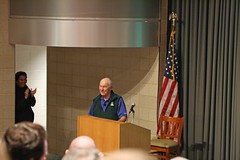
We watched a 20-minute clip from a DVD about the general, and then he spoke for about an hour and a half, discussing his experiences from World War II onward, and taking questions from the audience.
Some of his recollections and observations that I can remember, in no particular order:
- General Yeager has flown nearly every aircraft in the Air Force inventory, and myriads of planes that never made it in to service.
- His favorite jet currently in American service is the F-15E. Given his opinions, one can surmise that he believes taxpayer resources would have been better spent upgrading and improving this aircraft, rather than investing in the F-22 and F-23. He referred to the F-22 specifically, as well as the F-16, as "great for air shows," but not so great for modern air combat.
- In October of last year, he went to France and flew the Airbus A380. General Yeager was very impressed with the "hotel with wings" (his words), and its stability. He told us of the flight tests he took part in with the water drums loaded throughout the fuselage (to simulate passenger and equipment weights), and how they would be moved about to change the plane's center of gravity, and the 380 would take it all in stride.
- During the Airbus visit, he was reunited with some of the Maquis resistance fighters who'd sheltered him for three months after he was shot down over southern France. "There's not many of them left; they're all older than me."
- He's convinced France is the second-best country in modern aviation, behind the United States.
- He lamented the consolidation of the aircraft industry in the U.S. When he was a test pilot, flying 25-30 different aircraft each month, the Defense Department could choose from myriad contractors: Lockheed, North American, Grumman, Corvair, Rockwell, Boeing, Bell, Martin, and McDonnell Douglas. It was extremely competitive, and the country was rewarded with the best possible aircraft for the best possible price. Now the industry has contracted to only three players, and these companies are free to "fleece" the government.
- On shooting down a Me 262 during World War II: while on a mission, Yeager's squadron encountered several 262s, but none engaged the P-51s. While passing over a particular area, the squadron came under antiaircraft fire. While spying where the flak was coming from, Yeager noted the guns were protecting a small airfield, and he saw 262s on the ground. He also saw a 262 coming in for a landing. He then lined up behind the 262 and destroyed it; "not very sportmanslike, but what the hell" was the general's sentiment. He noted with amusement that an antiaircraft battery at the end of the runway had turned its gun on him, now racing down the length of the runway about six feet off the deck, and, missing his Mustang, was hitting its own hangars at the opposite end of the field.

- He thought Tom Wolfe's portrayal of him and the Air Force in The Right Stuff was accurate; "pretty much how it really was." On NASA, the German scientists who helped build the rockets, Vice-President Johnson: not so much. "There was a lot of embellishment." (Yeager was a technical adviser for the movie, and flew several of the featured aircraft for the film.)
- Regarding the early period of space flight research in the U.S.: the Air Force owned the space program. They were in charge of all the training of pilots-cum-astronauts, ran the test facilities and aircraft, all on a miniscule budget. They did all of this with nary a mention in the press. Then Sputnik went up, Eisenhower made space a priority, NASA was born out of NACA, and the place became a bureaucratic and budgetary mess "and has been that way since." I gathered that he thought it outrageous that each of the original Mercury astronauts got his own press agent. Yeager has a very strong opinion about the space program, from which one might surmise that today it would be a very different, and likely much more successful, animal if it were still under the Air Force's purview.
- He does not regret ever going into space. He is especially proud that the men who came through the USAF Aerospace Research Pilot School, of which he was the first commandant, were among the Gemini, Apollo, and Space Shuttle astronaut crews.
- Though he retired from the Air Force in 1975, he continued to test fly for the Air Force. His payment was a dollar a year. When presented with the offer, Yeager says his only response was "I don't have to pay for the fuel, do I?" He's also performed test flights for many private companies, including foreign ones (viz: Airbus, above).
- Regarding his selection to fly the X-1: his dad was a natural gas driller in West Virginia, and as a 12 year-old, Yeager would help his dad repair dome regulators, which lowered the pressure of the gas so it could be more easily sent through pipes, atop drilled wells. Part of the gas system for the X-1's rockets included the same type of dome regulators. Yeager contends "In some ways, I knew the X-1's fuel system better than the guys who designed and built it, because I grew up with it." His background knowledge factored in to his selection.
- After three months in southern France, the Maquis resistance managed to get Yeager across the Pyrennes into Spain. Spain was neutral at the time, along with Switzerland and Sweden. Combatants who ended up in these countries were expected to pretty much ride out the war there. Spain had no petroleum resources of its own at the time, and due to the war, was having difficulty importing it. The U.S. agreed to an exchange of petroleum for several pilots, including Yeager, who had ended up there. The general joked, "Now I don't know how many barrels each of us was worth..."
- Improvement in technology aside, Yeager is indignant over the number of troops injured and killed by IEDs over the past few years on Iraq. He told us about how the Air Force used to assist the troops on the ground in the removal--via detonation/destruction--of roadside mines during Vietnam. (This involved the Bird Dog observer aircraft spotting and marking new disturbances in the ground alongside the roads, with ground attack aircraft following, strafing the marked positions.) He rhetorically wondered why something similar wasn't being done in Iraq, and contends it's because those running the war for the various services didn't serve in Vietnam.
- His last flight in a military jet of any kind was on 18 September 2007. Looking back through old flight logs, he discovered his first official flight in a military aircraft of any kind was 18 September 1942. He was obviously pleased with this 65-year run of flying military aircraft.
- He's a modest man who doesn't look at his accomplishments in the same light as the rest of us. One can understand that; living in the moment, you oftentimes fail to appreciate it for what it was at the time it happened. Yeager contends that he was simply in the right place at the right time, with the right set of skills.
Given that General Yeager’s 86th birthday will be on Friday, the 13th, a cake was brought out and the entire audience sang “Happy Birthday” to him. He thought it was a kick. He mingled briefly afterward, and had a slice of cake. There was no official signing or greeting line; the general either hadn’t planned to, or was too tired, to sign books and other items. All perfectly understandable.
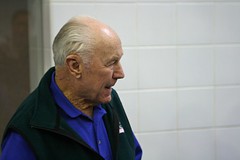
It was disappointing to not be able to greet General Yeager personally, shake his hand, and thank him for his decades of service. But I am not disappointed in the overall experience. It was fantastic! If you ever have the chance to meet with General Yeager or hear him speak, do not miss such an opportunity with an authentic American hero.
Much love and thanks to Kelly for making last night possible for me! I love you, sweetheart!
"A republic, if you can keep it."
"Many Americans would be surprised to learn that the word 'democracy' does not appear in the Declaration of Independence, or the U.S. Constitution. Nor does it appear in any of the constitutions of the fifty states. The Founders did everything they could to keep us from having a democracy." Democracy = mob rules. Republic = rule of law. Keep this in mind when American politicians--of any stripe--talk about the "will of the people". This is worth ten minutes of your time if you've forgotten--or never got--this lesson in civics class.